블로그

Collet Materials and Heat Treatment: From Spring Steel to Hardened Alloy
Apr 30,2026

Collet Materials and Heat Treatment: From Spring Steel to Hardened Alloy

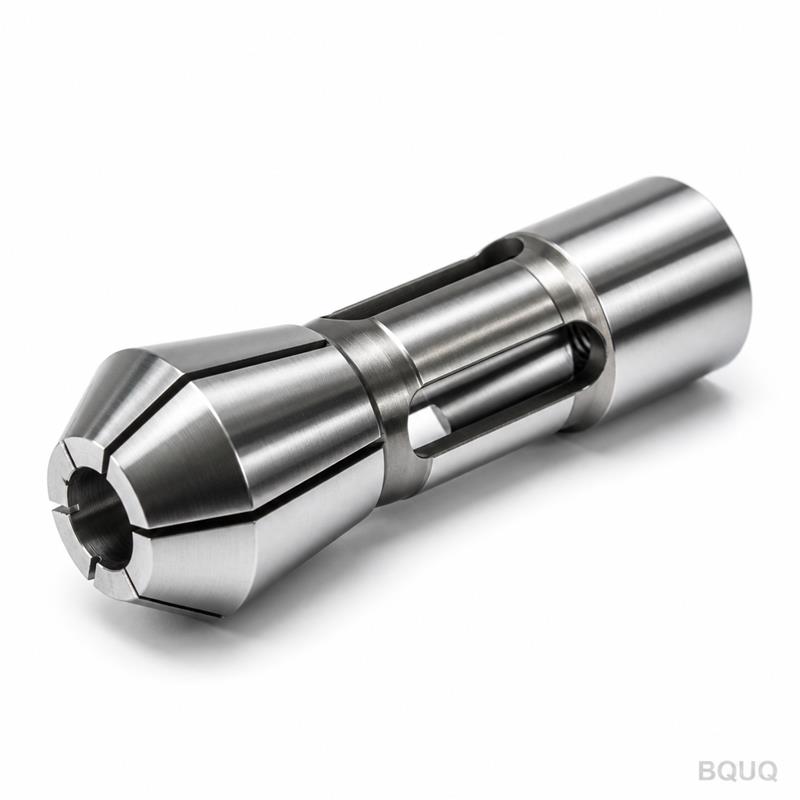
Collet material and heat treatment decide the three properties that make or break a collet: the spring behavior of the slotted fingers, the wear resistance of the bore, and the stability of the ground geometry. Spring steel bodies typically run 45–52 HRC so the fingers flex millions of cycles without cracking; hardened alloy bores can reach 58–62 HRC where wear dominates — and the whole part must stay dimensionally stable through grinding.

A collet is a contradiction machined from one piece of metal. Its fingers must behave like a spring, opening and closing tens of thousands of times a shift. Its bore must behave like a bearing race, resisting abrasive bar stock and holding a micron-level geometry. Its cone must seat true against the chuck without galling. No single hardness serves all three jobs, so collet makers choose the steel and the heat treatment to balance them — and the balance is different for a spring collet than for a solid collet or a chuck component.

What Each Collet Element Asks of the Material

Break the collet into functional zones and the material demands become clear. The slotted finger section needs fatigue strength: it bends every cycle, and a crack starting at a slot root ends the collet's life — or worse, sends a fragment into the machine. The bore needs hardness and wear resistance: bar stock sliding through it at feed is an abrasive event measured in thousands of cycles. The cone needs a tough, gall-resistant surface that seats repeatedly against the chuck taper.

Collet zoneDominant requirementTypical hardness (industry)
Slotted fingersFatigue strength, elastic recovery45–52 HRC typical
BoreWear resistance, dimensional stability55–62 HRC typical
Cone/seatingGall resistance, toughness45–58 HRC typical
Solid collet bodyStiffness, wear resistance58–62 HRC typical

The numbers are typical trade ranges, not a single standard — the right value depends on collet size, slot geometry and duty. The pattern is the point: the zones that must flex are kept tougher and slightly softer, while the zones that must survive abrasion are hardened to the practical limit.

Spring Steel: The Classic Collet Body

Spring steel is the traditional answer for slotted collet bodies because it is designed for exactly this duty: elastic deflection, cycle after cycle, without taking a permanent set. The metallurgy is a medium-to-high carbon or alloy steel hardened and tempered to a spring condition — hard enough to return to shape, tempered enough not to crack at the slot roots.

The tempering trade is the heart of the choice. Tempered too hard, the fingers snap after a few thousand cycles — the classic "new collet cracked in a week" failure, usually from a hardness spec copied from a wear part. Tempered too soft, the fingers take a permanent set, the collet stops opening fully, and the bar drags on feed. The correct temper leaves the fingers elastic at the operating deflection of the bore size, which is why small collets with proportionally thicker fingers can run harder than large thin-walled ones.

Steel familyTypical use in colletsKey property
High-carbon spring steelSlotted spring collet bodiesElastic recovery, fatigue life
Silicon-manganese spring steelHeavier-duty spring colletsHigher fatigue strength
Chromium alloy steelHardened collets and solid colletsDeep hardening, wear resistance
Bearing-type alloy steelHigh-wear bores, solid colletsExtreme hardness, stability

Grain direction and cleanliness matter as much as grade: a slot cut across a poor inclusion stringer is a pre-existing crack. Reputable collet production starts from quality-assured bar and controls the steel source, because fatigue life cannot be inspected into a finished collet — it is bought at the melt.

Hardening and Tempering: The Process Order

Heat treatment for a spring collet follows a deliberate sequence, and the order matters as much as the temperatures. The blank is machined with the bore slightly undersized and the slots either uncut or rough-cut. It is then hardened: austenitized, quenched, and tempered to the target hardness for the body's spring duty. Only after the steel is stable does precision work begin — the bore is ground to final size and the cone is finished, because grinding after hardening is what keeps the geometry true on a part that will not move again.

Slots are a special case. Cutting slots after hardening risks cracks at the roots; cutting them before hardening risks distortion that closes or opens the slot width. Production practice varies, but the finish-ground bore and the final slot geometry are always done on the hardened part, with stress relief where the process demands it. Slot roots are radiused, never left square — a square root is a fatigue notch that concentrates every cycle into one line.

Process stepPurposeTypical outcome
Machine blankNear-net body, bore and coneStable stock for treatment
Harden and quenchFull hardness transformationHard, wear-capable steel
TemperRestore toughness and spring behavior45–52 HRC body typical
Grind bore and coneTrue geometry on stable steelMicron-level concentricity
Cut/finish slotsFinal flex geometryRadiused roots, controlled width
Final inspectionBore, cone, runout, hardness checksClass certificate per batch

The takeaway: hardening happens before finish grinding, never after. A collet ground then hardened has moved by the time it reaches you, and its runout class is fiction. When a supplier cannot state the process order, treat the runout certificate with suspicion.

Hardened Alloy Bores and Solid Collets

Where wear dominates — solid collets, master collets, and the bore zone of heavy-duty spring collets — makers turn to chromium and bearing-type alloy steels that harden deep and uniformly. These grades reach the high end of the hardness range and keep their geometry because they are through-hardened rather than case-hardened; a thin case on a collet bore would wear through and expose soft metal exactly where the bar slides.

Solid collets can run at the top of the hardness range because nothing has to flex. The trade-off appears at the other end of the collet's life: a very hard collet is brittle in thin sections and more likely to chip at bore edges if a bar loads crooked. Solid collet design manages this with section thickness and edge treatment rather than by softening the steel.

Matching Material to Duty

Selection guidance is simpler than the metallurgy suggests. Bar-fed spring collets on autos and Swiss lathes: spring steel body, tempered for fatigue, bore hardened and ground. Solid collets for grinding and hard turning: alloy steel through-hardened to the top range. High-wear or abrasive stock (stainless, cold-drawn alloys): specify the harder bore treatment and plan shorter bore-life intervals. Soft stock (brass, aluminum): hardness can drop, but the fatigue spec of the fingers stays.

Two practical cautions. First, hardness is a range, and the certificate should state it: a collet "hardened" without a number tells you nothing. Second, never re-harden a worn collet — the slots and bore were finished after the original treatment, and a second quench distorts the geometry beyond reclamation. Replace, do not re-treat.

What to Ask a Collet Supplier

Ask four questions: what steel family the body uses, the target hardness range with certificate, whether the bore is ground after hardening, and what fatigue life the slot design targets at your bore size. The answers separate a factory that treats collets as precision springs from one that machines shapes and hardens them as an afterthought.

At BQUQ the collet lines run this discipline in-house: spring collets for the 36/46/52/60/630/643 families machined from spring steel and hardened alloy, bores ground after heat treatment, and hardness and runout verified before shipment — all under ISO9001 process control in the same Dongguan factory that runs our CNC, stamping, spring and heat sink lines. Browse the auto-lathe collet range and the Swiss and 2J collet chucks they seat in, and keep the other end of the life cycle in mind with our collet maintenance guide — material choice decides how long a collet lasts, but care decides whether it dies of old age or of neglect. Send your machine and bar details to sc@bquq.com for a quote within 12 working hours.

Have a drawing? Get a factory quote within 12 hours.
Email sc@bquq.com or WhatsApp +86 137 1315 7787 with your PDF/DXF/STEP file. An engineer reviews it and replies with price, lead time and DFM notes on working days.

Frequently Asked Questions

Q: Why is a collet both hard and springy?

A: Different zones need different properties. The slotted fingers must flex elastically for millions of cycles, so they are tempered to a spring condition around 45–52 HRC typical; the bore must resist abrasion, so it is hardened toward 55–62 HRC typical. One part, two heat-treatment targets.

Q: Why did my new collet crack at a slot?

A: The usual causes are a slot root left square instead of radiused, an over-hard temper that removed toughness, or a steel defect at the slot. A crack in the first weeks of service is a manufacturing issue — request the hardness certificate and replace the collet.

Q: Should the bore be ground before or after hardening?

A: After. Grinding the bore and cone on the hardened part is what guarantees the geometry stays true for the life of the collet. Hardening after grinding distorts the bore and makes the runout class meaningless.

Q: Can a worn collet be re-hardened and reused?

A: No. Re-hardening distorts the finished bore, cone and slots beyond practical reclamation, and the fatigue history of the fingers is already spent. Replacement is cheaper than the scrap parts a re-treated collet will produce.

Q: What certificate should come with a collet?

A: At minimum, material identity, the hardness range actually measured, and the bore-to-cone runout class per piece or per batch. BQUQ ships hardness and runout inspection data with each collet batch — ask for it from any supplier before you pay.

Authored by the BQUQ Engineering Team. BQUQ is an ISO9001-certified source factory in Dongguan, China, running CNC machining, metal stamping, custom springs, heat sink and collet lines under one roof. Send drawings to sc@bquq.com or WhatsApp +86 13713157787 for a quote within 12 working hours. www.bquq.com


견적은 당사에 문의하십시오.
견적 받기
우리는 당신의 온라인 경험을 향상시키기 위해 쿠키를 사용합니다. 이 사이트를 계속 탐색하면 쿠키 사용에 동의하게 됩니다.

Cookies

서비스에 액세스하거나 사용하기 전에 약관 및 이 정책을 읽어보십시오. 본 정책 또는 약관에 동의할 수 없는 경우 당사의 서비스에 액세스하거나 사용하지 마십시오. 당사의 서비스를 사용하여 유럽 경제 지역 외부의 관할권에 있는 경우 귀하는 약관에 동의하고 본 정책에 설명된 개인 정보 보호 관행에 동의합니다. 사전 통지 없이 언제든지 이 정책을 수정할 수 있으며, 변경 사항은 이미 보유하고 있는 개인 정보뿐만 아니라 정책이 수정된 후 수집된 새로운 개인 정보에도 적용될 수 있습니다. 변경하면 이 정책의 맨 위에 있는 날짜를 수정하여 알려드립니다. 본 정책에 따라 귀하의 권리에 영향을 미치는 개인 정보를 수집, 사용 귀하가 유럽 경제 지역, 영국 또는 스위스(총체적으로 "유럽 국가")가 아닌 다른 관할구역에 있는 경우, 변경 통지를 받은 후에도 서비스를 계속 액세스하거나 사용하는 것은 업데이트된 정책을 수락한다는 귀하의 인정에 해당합니다. 또한 서비스의 특정 부분의 개인 정보 처리 관행에 대한 실시간 공개 또는 추가 정보를 제공할 수 있습니다. 이러한 통지는 이 정책을 보완하거나 개인 정보 처리 방법에 대한 추가 선택권을 제공할 수 있습니다.
CookiesCookies are small text files stored on your device when you access most Websites on the internet or open certain emails. Among other things, Cookies allow a Website to recognize your device and remember if you've been to the Website before. Examples of information collected by Cookies include your browser type and the address of the Website from which you arrived at our Website as well as IP address and clickstream behavior (that is the pages you view and the links you click).We use the term cookie to refer to Cookies and technologies that perform a similar function to Cookies (e.g., tags, pixels, web beacons, etc.). Cookies can be read by the originating Website on each subsequent visit and by any other Website that recognizes the cookie. The Website uses Cookies in order to make the Website easier to use, to support a better user experience, including the provision of information and functionality to you, as well as to provide us with information about how the Website is used so that we can make sure it is as up to date, relevant, and error free as we can. Cookies on the Website We use Cookies to personalize your experience when you visit the Site, uniquely identify your computer for security purposes, and enable us and our third-party service providers to serve ads on our behalf across the internet.We classify Cookies in the following categories: ●  Strictly Necessary Cookies ●  Performance Cookies ●  Functional Cookies ●  Targeting CookiesCookie ListA cookie is a small piece of data (text file) that a website – when visited by a user – asks your browser to store on your device in order to remember information about you, such as your language preference or login information. Those cookies are set by us and called first-party cookies. We also use third-party cookies – which are cookies from a domain different than the domain of the website you are visiting – for our advertising and marketing efforts. More specifically, we use cookies and other tracking technologies for the following purposes:Strictly Necessary CookiesThese cookies are necessary for the website to function and cannot be switched off in our systems. They are usually only set in response to actions made by you which amount to a request for services, such as setting your privacy preferences, logging in or filling in forms. You can set your browser to block or alert you about these cookies, but some parts of the site will not then work. These cookies do not store any personally identifiable information.Functional CookiesThese cookies enable the website to provide enhanced functionality and personalisation. They may be set by us or by third party providers whose services we have added to our pages. If you do not allow these cookies then some or all of these services may not function properly.Performance CookiesThese cookies allow us to count visits and traffic sources so we can measure and improve the performance of our site. They help us to know which pages are the most and least popular and see how visitors move around the site. All information these cookies collect is aggregated and therefore anonymous. If you do not allow these cookies we will not know when you have visited our site, and will not be able to monitor its performance.Targeting CookiesThese cookies may be set through our site by our advertising partners. They may be used by those companies to build a profile of your interests and show you relevant adverts on other sites. They do not store directly personal information, but are based on uniquely identifying your browser and internet device. If you do not allow these cookies, you will experience less targeted advertising.How To Turn Off CookiesYou can choose to restrict or block Cookies through your browser settings at any time. Please note that certain Cookies may be set as soon as you visit the Website, but you can remove them using your browser settings. However, please be aware that restricting or blocking Cookies set on the Website may impact the functionality or performance of the Website or prevent you from using certain services provided through the Website. It will also affect our ability to update the Website to cater for user preferences and improve performance. Cookies within Mobile ApplicationsWe only use Strictly Necessary Cookies on our mobile applications. These Cookies are critical to the functionality of our applications, so if you block or delete these Cookies you may not be able to use the application. These Cookies are not shared with any other application on your mobile device. We never use the Cookies from the mobile application to store personal information about you.If you have questions or concerns regarding any information in this Privacy Policy, please contact us by email at . You can also contact us via our customer service at our Site.