블로그

Jul 06,2026

"Power Chucks: Hydraulic and Pneumatic Gripping for Production Turning"

A power chuck is a self-centering chuck that opens and closes under hydraulic or pneumatic pressure instead of by hand, giving a production lathe fast, repeatable part changes with a grip force set by the operator rather than by arm strength. Hydraulic actuation carries the force; pneumatic actuation carries the speed; both exist because manual chucking is the bottleneck nobody budgets for.

On a manual lathe the chuck is a fixture. On a production lathe the chuck is a mechanism — it cycles thousands of times per shift, must grip with a repeatable force, and must not let go when spindle speed and cutting forces fight it. Power chucks automate that cycle. This guide covers how they work, the hydraulic-versus-pneumatic decision, and the grip-force physics that decide whether your parts stay put.

Anatomy of a Power Chuck

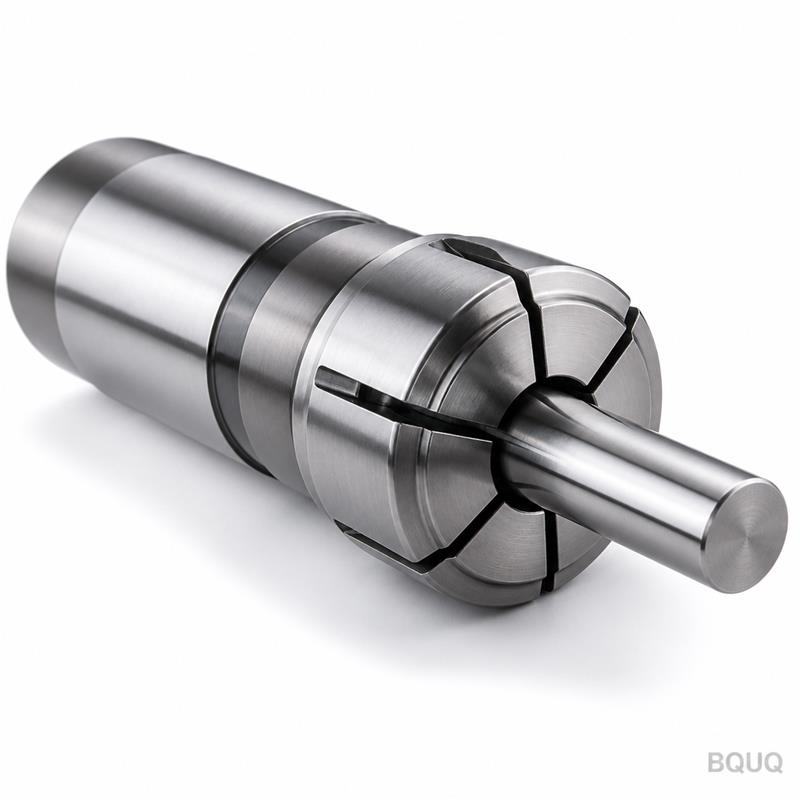
A power chuck system has four parts. The chuck body mounts on the spindle nose. Inside it, a mechanism — usually a wedge-hook or lever linkage — converts axial motion into radial jaw movement. The actuator is a hydraulic or pneumatic cylinder mounted behind the spindle, connected by a draw tube through the spindle bore. And the jaws, typically three, carry hardened top jaws or machinable soft jaws that actually touch the part.

The mechanism matters because it defines the chuck's personality. Wedge-hook chucks are the production standard: stiff, accurate, and their grip force can be adjusted by regulating pressure. Lever-type chucks hold force better at speed in some designs because the linkage geometry compensates for centrifugal effects. Scroll chucks are the manual ancestor. For bar work, a through-hole chuck lets stock pass through the spindle; for chucked blanks, a closed center gives more rigidity.

Chuck typeActuationTypical strengthsTypical limits
Wedge-hook power chuckHydraulic or pneumaticStiff, accurate, adjustable forceJaw travel limited per size
Lever-type power chuckHydraulicGood force retention at speedMore parts, higher cost
Scroll chuckManual (power versions exist)Low cost, wide jaw travelSlower, less repeatable force
Through-hole power chuckHydraulic/pneumaticBar and chucked work on one spindleSmaller jaw force vs closed center

Hydraulic vs Pneumatic: The Real Trade

Pneumatic chucks are cheaper and faster to cycle — shop air is everywhere and a pneumatic cylinder strokes quickly. But air is compressible, so pneumatic grip is softer and force falls as the system leaks or the compressor sags. Hydraulic chucks cost more and need a pump and reservoir, but oil is nearly incompressible: grip is stiff, force is repeatable, and the same chuck size can deliver substantially higher grip at the jaws. The choice tracks the workpiece: light alloys and delicate parts run happily on pneumatic; steel and aggressive roughing want hydraulic.

FactorPneumaticHydraulic
Typical supplyShop air, 6–8 barOil, up to ~70 bar typical
Stiffness of gripSoft (air compresses)Stiff (oil nearly incompressible)
Cycle speedFastSlightly slower but adjustable
Typical grip force range (6 in chuck, typical)~5–15 kN~20–50 kN
Cost and maintenanceLowHigher, oil system to maintain

Force figures are typical catalog ranges for a mid-size chuck and vary with pressure, jaw weight and design. The pattern to remember: pneumatic wins on speed and price for light work; hydraulic wins wherever grip stiffness and force decide the cut.

Grip Force at Speed: The Physics Nobody Escapes

Here is the number that catches new operators: a chuck's grip force at rest is not its grip force at 4,000 rpm. Jaws are masses on a rotating carrier, and centrifugal force tries to throw them outward, opposing the grip. The bigger and heavier the jaws — soft jaws especially — the more force you lose as speed climbs. A chuck rated for full grip at rest can lose a third or more of that grip at high speed with heavy jaws.

Spindle speedTypical grip force retained (illustrative)
0 rpm (static rating)100%
~2,000 rpm, light jaws~90–100%
~4,000 rpm, light jaws~70–85%
~4,000 rpm, heavy soft jaws~50–70%

These are illustrative retention patterns, not a universal curve — every chuck maker publishes a grip-force-versus-speed chart for their model and jaw set, and you should run from any supplier that cannot show one. The operational rules: machine soft jaws light, add a safety factor to grip force for heavy roughing, and never assume the static rating applies at your top speed.

Jaws, Safety and Maintenance

Top jaws come in two philosophies. Hardened top jaws with serrated or pie-shaped inserts are for repeat jobs at fixed diameters. Machinable soft jaws are bored or turned to the exact part contour, which spreads grip over more area — the right answer for thin-wall parts, odd shapes and jobs where marking the workpiece is not acceptable. Whatever the jaw, the grip line should be as low as practical to reduce bending on the part, and grip force should be set for the part, not for the chuck's maximum.

Safety on a power chuck is not optional: pressure loss must fail the chuck closed or be interlocked against spindle start, draw-tube stroke must be verified before the door closes, and grip force should be periodically measured with a force gauge rather than assumed from the pressure gauge. Maintenance is mostly lubrication of the wedge ways and checking jaw serration wear — a chuck that stops re-centering is usually a dirty or dry chuck before it is a worn one. Our collets vs jaw chucks comparison covers when to step down from jaw chucks to collets for small round work, and the 2J collet chuck guide shows the collet alternative for Swiss and auto lathes.

When the job needs a chuck or collet chuck machined to a real tolerance — jaw seats, tapers and locating bores in the 0.005 mm class — BQUQ machines power chucks and Swiss-type chucks plus auto-lathe collets on CNC equipment under one ISO9001 roof in Dongguan. Send your spindle nose, bar or blank sizes and jaw requirements to sc@bquq.com for a quote within 12 working hours.

Have a drawing? Get a factory quote within 12 hours.
Email sc@bquq.com or WhatsApp +86 137 1315 7787 with your PDF/DXF/STEP file. An engineer reviews it and replies with price, lead time and DFM notes on working days.

Frequently Asked Questions

Q: How much grip force do I actually need?

A: Enough that the part cannot rotate or pull out under the heaviest cut, with a safety margin — typically 2–3 times the calculated cutting torque requirement. Measure it with a grip force gauge at operating speed rather than trusting the pressure gauge alone.

Q: Is a pneumatic chuck accurate enough for precision turning?

A: Yes, for many jobs — the chuck's centering accuracy is set by its mechanism and jaws, not the fluid. Pneumatic chucks hold their accuracy fine; their limit is softer, less repeatable grip force, which matters more for heavy cuts than for tolerance.

Q: Why does my part slip at high rpm when it held fine at low speed?

A: Centrifugal force on the jaws is fighting your grip, and it grows with the square of speed. Heavy soft jaws lose the most. Check the maker's force-versus-speed chart and either raise pressure, lighten the jaws, or reduce top speed.

Q: How often should I check grip force on a power chuck?

A: Schedule a grip force check at every major job change and at regular intervals — monthly is common for production cells — plus any time you change jaw type or see a quality shift. Force decays with wear and contamination long before the chuck looks bad.

Q: Can I run bar stock through a power chuck?

A: Only through a through-hole chuck with a spindle and draw tube that clear the bar. If bar work is in your future, buy the through-hole version from the start — retrofitting a closed-center chuck to bar work means replacing it.

Authored by the BQUQ Engineering Team. BQUQ is an ISO9001-certified source factory in Dongguan, China, running CNC machining, metal stamping, custom springs, heat sink and collet lines under one roof. Send drawings to sc@bquq.com or WhatsApp +86 13713157787 for a quote within 12 working hours. www.bquq.com


견적은 당사에 문의하십시오.
견적 받기
우리는 당신의 온라인 경험을 향상시키기 위해 쿠키를 사용합니다. 이 사이트를 계속 탐색하면 쿠키 사용에 동의하게 됩니다.

Cookies

서비스에 액세스하거나 사용하기 전에 약관 및 이 정책을 읽어보십시오. 본 정책 또는 약관에 동의할 수 없는 경우 당사의 서비스에 액세스하거나 사용하지 마십시오. 당사의 서비스를 사용하여 유럽 경제 지역 외부의 관할권에 있는 경우 귀하는 약관에 동의하고 본 정책에 설명된 개인 정보 보호 관행에 동의합니다. 사전 통지 없이 언제든지 이 정책을 수정할 수 있으며, 변경 사항은 이미 보유하고 있는 개인 정보뿐만 아니라 정책이 수정된 후 수집된 새로운 개인 정보에도 적용될 수 있습니다. 변경하면 이 정책의 맨 위에 있는 날짜를 수정하여 알려드립니다. 본 정책에 따라 귀하의 권리에 영향을 미치는 개인 정보를 수집, 사용 귀하가 유럽 경제 지역, 영국 또는 스위스(총체적으로 "유럽 국가")가 아닌 다른 관할구역에 있는 경우, 변경 통지를 받은 후에도 서비스를 계속 액세스하거나 사용하는 것은 업데이트된 정책을 수락한다는 귀하의 인정에 해당합니다. 또한 서비스의 특정 부분의 개인 정보 처리 관행에 대한 실시간 공개 또는 추가 정보를 제공할 수 있습니다. 이러한 통지는 이 정책을 보완하거나 개인 정보 처리 방법에 대한 추가 선택권을 제공할 수 있습니다.
CookiesCookies are small text files stored on your device when you access most Websites on the internet or open certain emails. Among other things, Cookies allow a Website to recognize your device and remember if you've been to the Website before. Examples of information collected by Cookies include your browser type and the address of the Website from which you arrived at our Website as well as IP address and clickstream behavior (that is the pages you view and the links you click).We use the term cookie to refer to Cookies and technologies that perform a similar function to Cookies (e.g., tags, pixels, web beacons, etc.). Cookies can be read by the originating Website on each subsequent visit and by any other Website that recognizes the cookie. The Website uses Cookies in order to make the Website easier to use, to support a better user experience, including the provision of information and functionality to you, as well as to provide us with information about how the Website is used so that we can make sure it is as up to date, relevant, and error free as we can. Cookies on the Website We use Cookies to personalize your experience when you visit the Site, uniquely identify your computer for security purposes, and enable us and our third-party service providers to serve ads on our behalf across the internet.We classify Cookies in the following categories: ●  Strictly Necessary Cookies ●  Performance Cookies ●  Functional Cookies ●  Targeting CookiesCookie ListA cookie is a small piece of data (text file) that a website – when visited by a user – asks your browser to store on your device in order to remember information about you, such as your language preference or login information. Those cookies are set by us and called first-party cookies. We also use third-party cookies – which are cookies from a domain different than the domain of the website you are visiting – for our advertising and marketing efforts. More specifically, we use cookies and other tracking technologies for the following purposes:Strictly Necessary CookiesThese cookies are necessary for the website to function and cannot be switched off in our systems. They are usually only set in response to actions made by you which amount to a request for services, such as setting your privacy preferences, logging in or filling in forms. You can set your browser to block or alert you about these cookies, but some parts of the site will not then work. These cookies do not store any personally identifiable information.Functional CookiesThese cookies enable the website to provide enhanced functionality and personalisation. They may be set by us or by third party providers whose services we have added to our pages. If you do not allow these cookies then some or all of these services may not function properly.Performance CookiesThese cookies allow us to count visits and traffic sources so we can measure and improve the performance of our site. They help us to know which pages are the most and least popular and see how visitors move around the site. All information these cookies collect is aggregated and therefore anonymous. If you do not allow these cookies we will not know when you have visited our site, and will not be able to monitor its performance.Targeting CookiesThese cookies may be set through our site by our advertising partners. They may be used by those companies to build a profile of your interests and show you relevant adverts on other sites. They do not store directly personal information, but are based on uniquely identifying your browser and internet device. If you do not allow these cookies, you will experience less targeted advertising.How To Turn Off CookiesYou can choose to restrict or block Cookies through your browser settings at any time. Please note that certain Cookies may be set as soon as you visit the Website, but you can remove them using your browser settings. However, please be aware that restricting or blocking Cookies set on the Website may impact the functionality or performance of the Website or prevent you from using certain services provided through the Website. It will also affect our ability to update the Website to cater for user preferences and improve performance. Cookies within Mobile ApplicationsWe only use Strictly Necessary Cookies on our mobile applications. These Cookies are critical to the functionality of our applications, so if you block or delete these Cookies you may not be able to use the application. These Cookies are not shared with any other application on your mobile device. We never use the Cookies from the mobile application to store personal information about you.If you have questions or concerns regarding any information in this Privacy Policy, please contact us by email at . You can also contact us via our customer service at our Site.