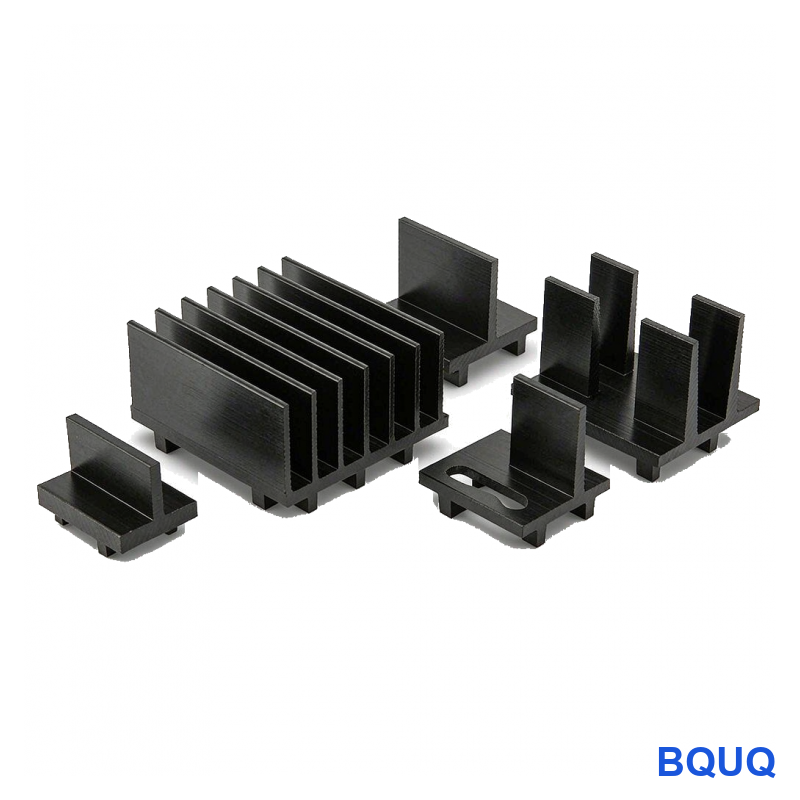
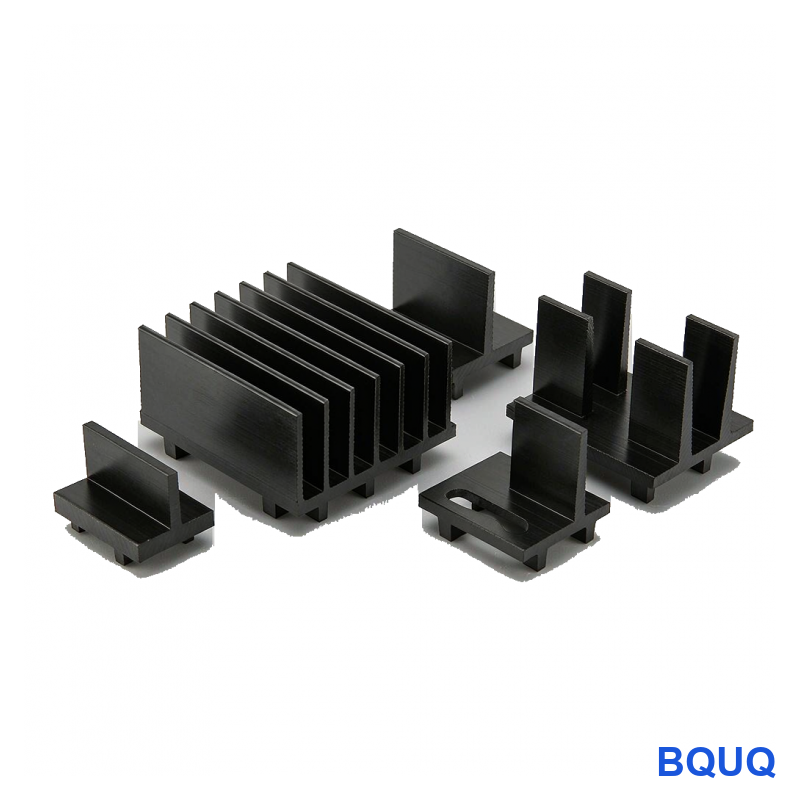
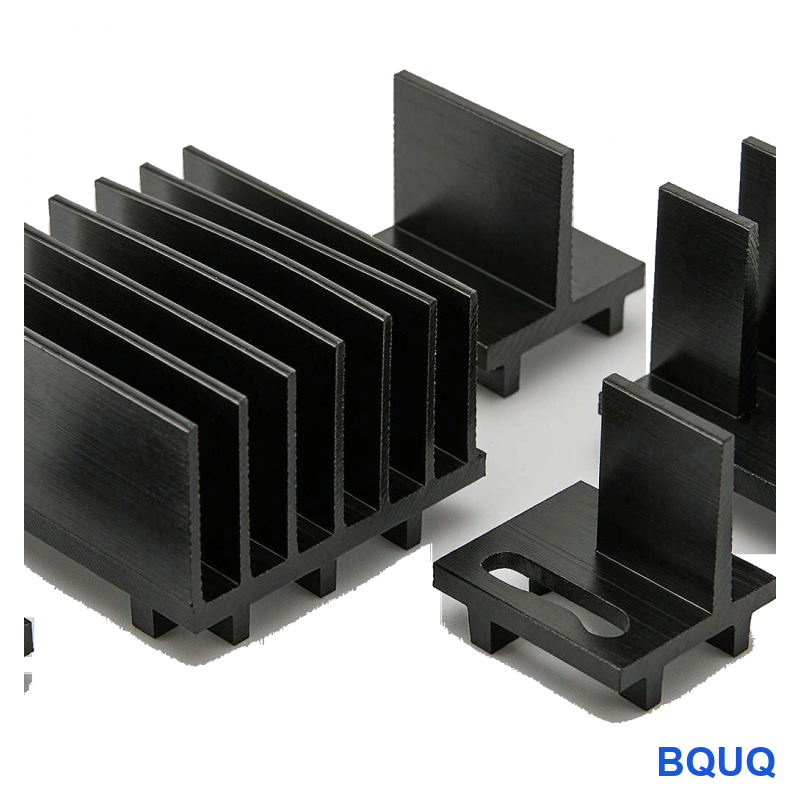
Seeed Studio XIAO용 알루미늄 방열판: 6061-T6 aluminium, 1.0 mm fins at 2.0 mm pitch, 0.05 mm over 100 mm flatness, 0.35 K/W thermal resistance. MOQ 50 pcs, ships in ...
Seeed Studio XIAO용 알루미늄 방열판
Seeed Studio XIAO용 알루미늄 방열판: 6061-T6 aluminium, 1.0 mm fins at 2.0 mm pitch, 0.05 mm over 100 mm flatness, 0.35 K/W thermal resistance. MOQ 50 pcs, ships in ...
Get a Fast Quote for This Part
Send us your drawing / quantity / material — reply within 24h.
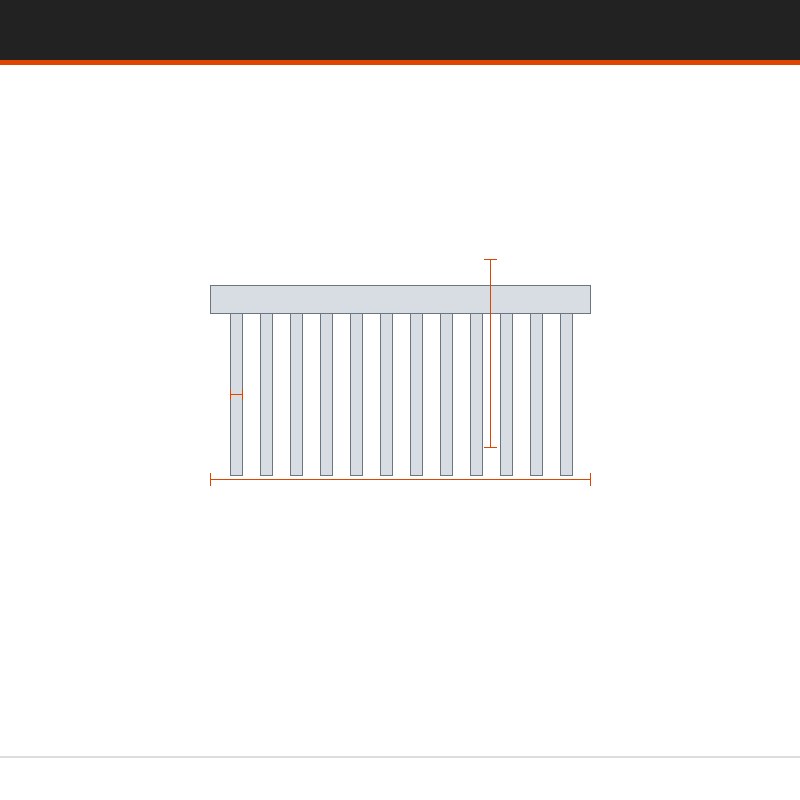
Our Seeed Studio XIAO용 알루미늄 방열판 uses 6061-T6 aluminium with 1.0 mm fins and a 1.5 mm base flat to 0.05 mm over 100 mm. Rated 0.35 K/W at ΔT = 60 K, it supports EV and OBC charger builds at 120,000 pcs monthly output with zinc-nickel plating, trivalent passivation as standard.
Design Approach and Process
Stamping gives a repeatable 1.0 mm fin profile that extrusion cannot hold: the die forms every fin in one stroke, so pitch stays within ±0.05 mm across a 120,000 pcs run.
Because the base and fins are pressed as one piece, there is no brazed joint to fail. 0.05 mm over 100 mm flatness on the mounting face is held directly from the tool, which keeps thermal interface contact uniform.
Low fin gauge is where stamping wins: 1.0 mm fins at 2.0 mm pitch give more surface per cubic millimetre than a machined or extruded profile of the same envelope.
Stamped construction tolerates batch variation better than extrusion: die wear shows up first as a measurable shift in fin pitch, which inspection catches at CMM 0.001 mm resolution rather than in the field.
Every stroke is dimensionally identical, so ±0.10 mm hole position carries across the batch. That is what makes EV and OBC charger volume programs repeatable.
Material Selection and Surface Finish
The standard material is 6061-T6 aluminium, supplied with zinc-nickel plating, trivalent passivation. For applications where EV and OBC charger exposure is a concern, we recommend the passivated route; where conductivity matters more than weight, copper C110 raises thermal performance and roughly doubles unit mass.
Tolerance Classes You Can Specify
General dimensions run to ±0.10 mm, with critical features such as ±0.03 mm on fin pitch held separately. Formed geometry inherits tooling repeatability of ±0.05 mm, and hole position is held to ±0.10 mm. Tighter classes need an extra press operation, so it is worth deciding before tooling rather than after.
Flatness is checked on a granite surface plate, 20 °C against a 0.05 mm over 100 mm limit, and fin pitch is verified optically at ±0.05 mm. Reports go out with each lot.
Each batch carries a CMM report from CMM 0.001 mm resolution. We record flatness, pitch, base thickness and hole position, and flag anything outside ±0.10 mm before it leaves the line.
We inspect 1.0 mm fin tips for burr and crack after forming, because stamping can split a root without shifting any drawing dimension. Burr limit is set per part.
Final containment is PE bag + export carton, 20 kg per carton. Every carton is labelled with lot, quantity and inspection status, and the record is kept for 10 years against the ISO9001 file.
In EV and OBC charger, the 0.35 K/W rating determines how much airflow the enclosure still needs. At EV and OBC charger junction temperatures, 1.0 mm fins at 2.0 mm pitch keep the delta-T inside the sensor budget.
EV and OBC charger customers typically specify 6061-T6 aluminium for corrosion reasons and then hold the drawing to ±0.10 mm. The 120,000 pcs line absorbs the volume without a second source.
In EV and OBC charger, the base usually doubles as the mounting interface. 1.5 mm with 0.05 mm over 100 mm flat gives a stable surface for the EV and OBC charger thermal pad.
EV and OBC charger designs often run a 2.0 m/s forced-air path. 0.35 K/W at ΔT = 60 K, natural convection means EV and OBC charger can hold its target with fan power below the acoustic limit.
Specifications
Parameter
Value / Range
Material
6061-T6 aluminium
Fin thickness
1.0 mm
Fin pitch
2.0 mm
Fin height
22 mm
Base thickness
1.5 mm
Base flatness
0.05 mm over 100 mm
Thermal resistance
0.35 K/W
Thermal test condition
ΔT = 60 K, natural convection
Surface finish
zinc-nickel plating, trivalent passivation
Size range
20 x 20 x 10 mm
FAQ: Your Questions Before Ordering
How does this compare to an extruded Seeed Studio XIAO용 알루미늄 방열판?
Extrusion is cheaper above roughly 500,000 pieces per year and gives a smoother profile. Stamping wins below that and wherever fin gauge drops below 0.5 mm, because extrusion cannot hold 1.0 mm consistently. For EV and OBC charger prototypes, tooling cost usually decides it.
Can the Seeed Studio XIAO용 알루미늄 방열판 be powder coated or plated?
Yes. Standard is zinc-nickel plating, trivalent passivation. Powder coating to RAL 9005 adds about 0.1 mm to the base; zinc-nickel is better for grounding. Note that any added coating sits between 6061-T6 aluminium and the airflow, so we do not coat the fin roots.
What are the packing and shipping conditions?
Standard packing is PE bag + export carton, 20 kg per carton. We quote FOB Shenzhen. Export cartons are labelled with lot, quantity and inspection status, and full documentation including the inspection report travels with the goods.
With 1.0 mm fins and standard PE bag + export carton, 20 kg per carton, damage is rare. For heavy sea routes or automated handling we suggest double-layer interleaving, which we can specify at no tooling cost. We have shipped 120,000 pcs per month this way without a transit claim in the last 3 years.
The plant is ISO9001 certified, and parts ship with RoHS and REACH declarations on request. Third-party SGS inspection can be arranged before the container is sealed, which is what most EV and OBC charger buyers specify.
The line sits in Dongguan in a single ISO9001 plant. 160 T presses cover the Seeed Studio XIAO용 알루미늄 방열판 family, and 120,000 pcs per month is current committed output.
Our EV and OBC charger experience runs back to the first tooling programme in 2015. That history is why the standard zinc-nickel plating, trivalent passivation and ±0.10 mm are conservative rather than optimistic.
We quote FOB Shenzhen and hold 50 pcs for sampling. Sampling is sample fee 30-80 USD, so a first evaluation does not require a production commitment.